
Medication & Supplement Organization
Create a clearer inventory and schedule for medications and supplements while preparing better questions for your physician, pharmacist or other licensed clinician.
Know What You Are Taking
We help organize names, timing, labels, supplement ingredients and household storage so it is easier to understand your current routine and spot questions that need professional review.
Ingredient & Formulation Education
We can compare supplement labels and inactive ingredients and discuss food-first lifestyle strategies where appropriate.
Questions for Your Care Team
If lifestyle changes improve how you feel or your health markers, medication needs may change—but those decisions belong with the prescribing clinician. We can help you prepare for that conversation.
Important Safety Boundary
Do not stop, reduce or split prescribed medication based on our guidance alone. Some medicines cannot be safely split or discontinued abruptly; a pharmacist or prescriber should confirm changes.
Planning a consultation in Greater New Orleans
Interested in medication & supplement organization? Tell us your city, your main question, and whether you prefer an in-person or remote educational conversation. Based in Harvey, Chemical Wellness discusses availability for New Orleans, the Westbank, Metairie, Kenner, and nearby communities. Scope, travel, and pricing are confirmed before booking.
Start with a reliable list
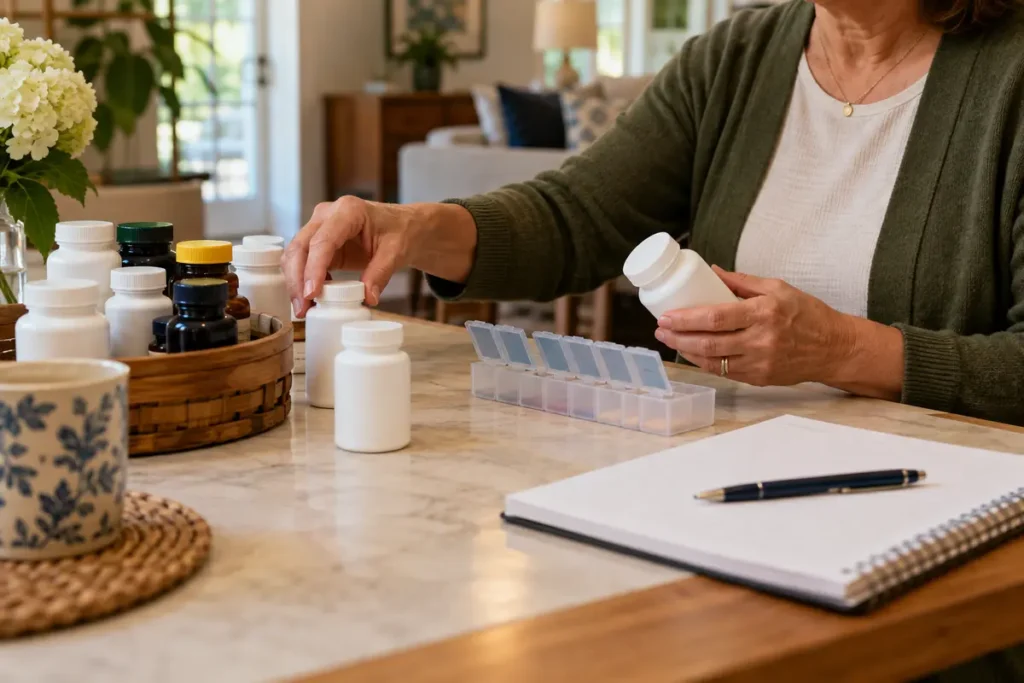
Medication and supplement organization should make information easier to find without changing the care plan. Gather the original labeled containers, written instructions and the list you currently use for appointments. Identify which items are current, which instructions are unclear and which questions need a pharmacist or clinician.
Keep this work separate from deciding whether a medicine is needed. An organized cabinet is useful only when the record is accurate and the household understands who is responsible for clinical decisions.
Keep original labels and directions connected
Do not lose the information needed to identify a product while trying to make storage look tidy. Original packaging can contain instructions, warnings, identifying details and storage requirements. Some items have special handling needs that should be clarified with a pharmacist.
We can help organize the record and prepare questions, but should not infer directions from a similar bottle or a remembered routine. When there is a conflict between labels and another instruction, have the responsible professional resolve it before making changes.
Record actual use separately from instructions
For an appointment, it can be helpful to distinguish what the label or clinician says from what you report doing. Keep those as separate factual entries rather than rewriting one to match the other. That helps a pharmacist or clinician identify a question that needs attention.
An educational organization session is not medication reconciliation by a licensed clinician. We can make the information more readable and easier to bring to the right person, while the professional assesses the clinical meaning.
Use a question list for uncertain items
A bottle may be old, duplicated in the cabinet or associated with instructions that have changed. Set aside the question in the record without assuming the medicine should be discarded or stopped. Ask the appropriate pharmacist about identification, current directions, storage and disposal.
If something cannot be identified confidently, do not guess. The practical goal is to keep uncertainty visible until it is resolved, not to create a neat-looking system that hides missing information or turns a routine household task into an unapproved treatment change.
Choose storage that follows the product requirements
Storage should consider the actual label, access needs and who lives in or visits the home. Keep medicines secured appropriately away from children and other people who should not have access. Do not assume every product belongs in the same room or container.
Ask a pharmacist about temperature, moisture, light or special storage requirements when unclear. We can help organize locations and labels around confirmed instructions. A decorative organizer should not replace necessary packaging or make products available to the wrong person.

Be careful with organizers and transfers
A pill organizer can appear convenient, but whether a particular product can be transferred and how it should be handled are questions for a pharmacist or qualified clinician. This service does not fill organizers, dispense medicines or decide timing and doses.
If you already have a clinician-approved system, we can help keep the associated written record and supply tasks organized. Keep the distinction clear so a practical reminder does not become a new medication instruction that someone follows without professional review.
Make household responsibilities clear
When more than one adult helps, agree on who maintains the list, who contacts the pharmacy and where confirmed instructions are stored. Do not place private information where visitors or children can access it simply for convenience.
A caregiver may need a different level of access from someone who only helps with shopping. Clarify consent before involving another person in the discussion. The organization work should support the person’s preferences and existing care arrangement rather than give an unrelated helper control of clinical decisions.
Prepare for appointments and refills
Keep the current record available for the appointments where it is needed, and mark questions you want answered. A practical supply checklist can note the contact responsible for refills and what information should be available when calling.
It does not authorize us to request prescriptions, make changes or communicate private clinical details on your behalf without a separately defined and appropriate process. For supplements, retain the complete label because a product name alone may not identify the ingredients or serving information involved.
Leave with a maintainable information system
A useful result might be a clear inventory, a secure location for instructions and a short list of unresolved questions. Choose a simple way to update it after a clinician changes the plan. Review the record when products change instead of assuming last month’s list remains correct.
To discuss practical organization support, text your city and whether the main difficulty is bottles, records or household coordination. Keep medicine names and sensitive records out of the initial message; first we can clarify whether this service fits.
Related practical help
Questions before you book
Do you dispense or administer medicine?
No. This service organizes information and practical household tasks. Dispensing, administration, clinical assessment and treatment decisions belong with appropriately qualified professionals and authorized caregivers.
Will you tell me to stop a prescription?
No. Changes to medicines, dose or timing must be discussed with the responsible clinician or pharmacist, not made through an organization session.
Can you help create an appointment list?
Yes. We can organize the product names, labels and questions into a readable record you can take to your qualified healthcare professionals.
Will you fill my pill organizer?
No. Suitability for transfer and the actual medication setup should be handled through an appropriate pharmacist, clinician or authorized care process.
Can supplements be on the same inventory?
Yes. A complete record can include supplements and nonprescription products so your pharmacist or clinician can review the actual routine.
What if two instructions disagree?
Keep both available and ask the responsible professional to resolve the difference. Do not guess or silently replace one set of directions with another.
Can a family caregiver participate?
Yes, with the person’s appropriate consent and within the agreed scope. Participation does not transfer clinical decision-making authority through this service.
Can you identify loose pills?
Do not rely on this service to identify unknown medicines. Ask a pharmacist and avoid guessing from appearance or a similar container.
Will you throw away old bottles?
Disposal decisions and safe methods should be clarified with a pharmacist or appropriate program. Products are not discarded simply to make a space look organized.
Can you set up reminders?
Practical reminders can be discussed around confirmed instructions. They must not introduce new dosing advice or replace the professional plan.
Is the website a medical-record portal?
No. Avoid sending sensitive records in a general inquiry. The first conversation can clarify practical needs without collecting a detailed medical history.
How do I request organization support?
Text 504.296.9696 with your city and the general information or storage problem. We can discuss the scope and what is appropriate to prepare.
Tell us what you need help with.
Text 504.296.9696 with your city and a little about your goals. Prefer a form? That works too.
Need a phone conversation instead? Call 504.296.9696.
Read ingredient labels with a clearer question
A product inventory is a useful starting point. The supplement ingredient and label review explains how to organize supplement information and prepare questions for your pharmacist or prescriber.
Turn these questions into a practical checklist.
No approach to choose first. Answer plain questions about your situation, meals and household, then receive focused next steps and an optional support request.
Get the Medication / supplement / GLP-1 questions checklist →