
Cleaning & Laundry Wellness
The sheets, towels and clothes are part of the fragrance conversation. Let’s simplify the wash and cleaning routine around what you actually need.
You live with the laundry after the cycle finishes.
The laundry room does not stop at the washer. The finished load becomes the pillowcase against your face, the towel after your shower and the clothes you wear all day. That is why I look at detergent, softener, scent beads, dryer sheets and finishing sprays together.
We can leave out optional scent steps, compare suitable fragrance-free products and write one routine everyone in the home can follow. We also check the machine and fabric instructions. A stubborn smell may need a maintenance or moisture question answered; adding another scent does not answer it.
For cleaning, we keep products matched to their actual job. A preference for fewer fragrances does not remove necessary hygiene tasks. Follow directions, store products safely and never improvise stronger mixtures. We can organize the cupboard so the next person knows which product belongs where.
Laundry Products
We can review detergents, fabric softeners, dryer sheets, scent boosters, stain products and other laundry supplies, discuss fragrance exposure and help compare replacement options.
Household Cleaning
Kitchen, bathroom, floor, glass and multipurpose cleaners can be simplified so you have effective products without a cabinet full of redundant formulas.
Use Matters Too
Ventilation, dilution, storage, surface compatibility and following product directions matter just as much as the ingredient list.
Organization
After replacements are chosen, we can organize laundry and cleaning areas for easier use and safer storage around children and pets.
Planning a consultation in Greater New Orleans
Interested in cleaning & laundry wellness? Tell us your city, your main question, and whether you prefer an in-person or remote educational conversation. Based in Harvey, Chemical Wellness discusses availability for New Orleans, the Westbank, Metairie, Kenner, and nearby communities. Scope, travel, and pricing are confirmed before booking.
Close the lid if available. Keep the whole routine.
Flushing can generate droplets and aerosols. Closing an available toilet lid is a reasonable household preference, but it is not a seal or a substitute for cleaning and handwashing. A 2024 study using a surrogate virus found that lid closure did not prevent restroom surface contamination in the tested toilets.
Keep toothbrushes and personal items away from splash areas, clean high-touch surfaces appropriately, wash hands with soap and water after the toilet, and deal with leaks or persistent dampness. Follow product directions and never mix cleaning chemicals. Added fragrance is not proof that a bathroom is clean.
Make the instructions easy for the whole household.
Agree where clean supplies belong, who replaces hand towels and how the bathroom gets cleaned. A simple routine works better than making the room smell stronger. For recurring rings or growth, inspect the moisture and cleaning pattern; appearance alone cannot identify a toxin or diagnose an illness.
Sources: toilet lid and surface-contamination study · CDC: hand hygiene. Related: fragrance and everyday exposure.
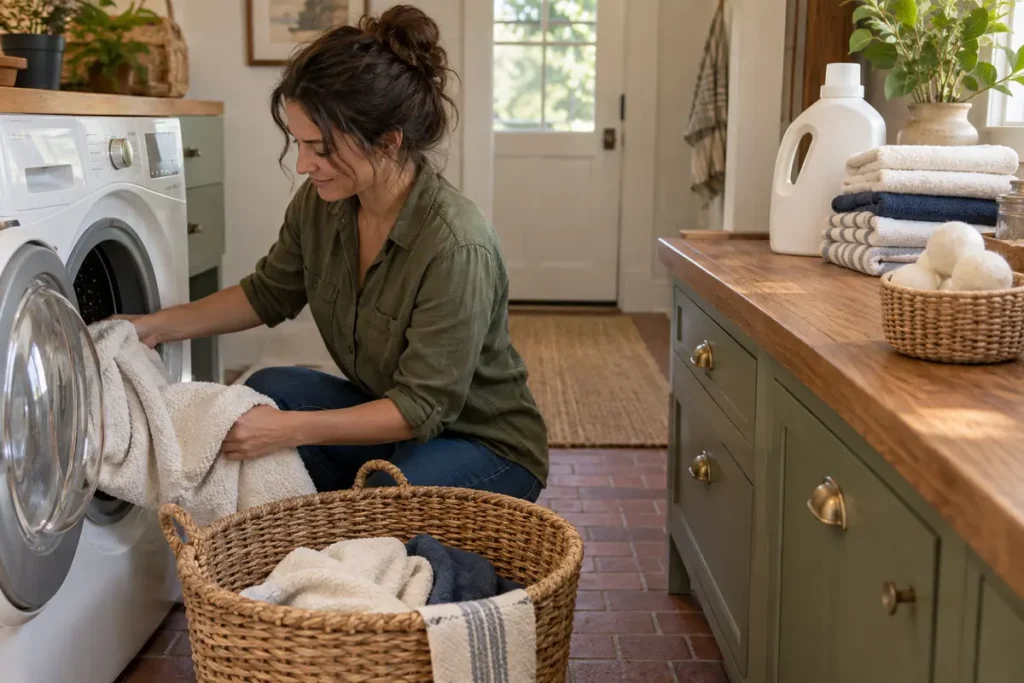
Map the laundry routine from basket to bedding
List the products used in a normal wash rather than start with a brand recommendation. Include detergent, stain treatment, fabric softener, scent beads, dryer sheets and any cleaner used on the machine. Note the load type, product amount and the instructions being followed.
Clothes, towels, sheets and baby items may pass through the same routine even when people think of them as separate categories. A clear inventory helps identify which products perform a cleaning task and which mainly add scent or a preferred feel. That gives you a practical starting point for simplifying the system.
Choose the task before choosing the product
A lightly used towel, a stained work shirt and a particular fabric may need different handling. Check garment-care and product instructions before assuming one mixture is appropriate for every load. Using more product is not automatically a better solution.
If the routine leaves residue, strong scent or a result you dislike, document the actual product and method rather than immediately add another additive. We can help organize the question and compare available information. Machine performance and a specific fabric problem may need the manufacturer or another appropriate specialist rather than a general household recommendation.
Understand a lower-fragrance preference
A family may want to reduce added scent on clothing and bedding. That can begin by identifying optional scent products and comparing the current detergent’s ingredient information with alternatives. Fragrance-free and unscented claims need to be read alongside the actual product information rather than judged only by smell.
A person with a diagnosed allergy should follow their own professional avoidance instructions. We can help make the shopping criteria usable without treating a product change as proof that a particular fragrance caused a condition or promising that every symptom will disappear.
Treat cleaning and disinfecting as different tasks
Everyday cleaning, targeted stain removal and a task requiring a disinfectant are not interchangeable. Follow the instructions for the actual product and use. Do not mix products in an attempt to make a stronger cleaner, and do not transfer them into unidentified drink bottles.
Keep the original labels and the equipment instructions available. A household review can identify which supplies are being used, whether several products duplicate the same task and what information is missing. It should not replace specific infection-control or occupational procedures that apply to a particular situation.
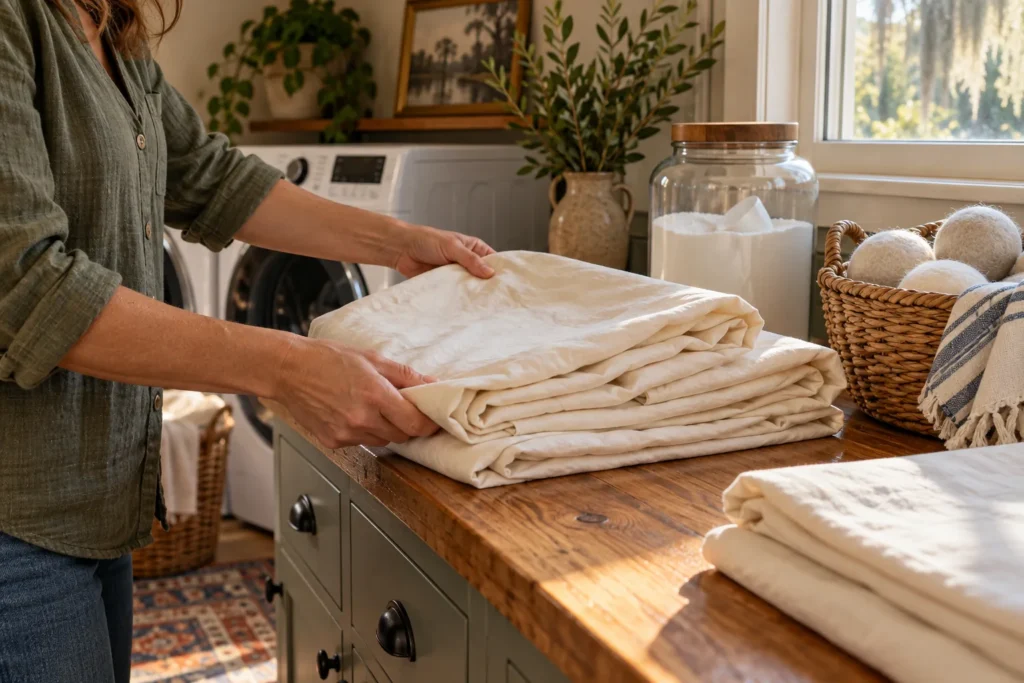
Keep the machine and storage part of the plan
Review where supplies are kept, who can reach them and how the machine is maintained according to its instructions. An appealing shelf arrangement is not useful if a child can access products or another adult cannot identify the contents.
Keep replacement supplies separate from the small set used routinely. If you rent or share laundry facilities, identify which parts of the routine you control. We can document the product list and maintenance questions; mechanical repair or a building problem should be addressed by the appropriate provider rather than concealed with another scented product.
Make the transition manageable
You do not have to discard every textile to start a different routine. Select one product or load category, make an appropriate change and record what happened. Keep the washing method compatible with the fabric and machine instead of relying on aggressive social-media stripping recipes.
When several changes are made at once, it becomes harder to know which change was useful. A staged plan can be easier to afford and maintain. If the concern is a skin or breathing symptom, the household information can be organized for a clinical conversation without turning the laundry review into a diagnosis.
Write instructions another caregiver can follow
A useful household note names the products, the appropriate routine and where the original instructions are stored. Keep it short enough for a partner, relative or caregiver to use without needing a separate explanation each time. Include a substitution criterion if a preferred product is unavailable.
For a baby or someone with specific professional instructions, make those requirements visible and avoid assuming every household member needs the same products. The goal is consistency around the actual task, not a complicated system that depends on one person remembering an extensive list of prohibited ingredients.
Connect laundry decisions with the rest of the home
Laundry connects with personal care, fragrance, bedding and visitor routines. A whole-home review can place these decisions together, while a focused scope can address just the product comparison and organization. Agree on whether you want advice, a written inventory or hands-on implementation before booking.
Equipment, replacement products and specialist work are separate unless explicitly included. Text 504.296.9696 with your city and the routine you want to simplify. We can begin with the products already in your home rather than require a new shopping list before the conversation.
Related practical help
Questions before you book
Should I stop using every laundry additive?
Start by identifying what each item does and whether it is needed for the actual task. Product and fabric instructions matter. Optional scent products can be considered separately from a necessary cleaning or specialist-care requirement.
Can you compare fragrance-free detergents?
Yes. We can review the ingredient information, intended use, cost per load and instructions. A product should fit the task and any specific professional advice relevant to the person using the textiles.
Is unscented always fragrance-free?
Do not assume so. Check the label and manufacturer’s explanation of the claim, especially when you are trying to avoid a particular ingredient or follow an allergy-related instruction.
Will changing detergent cure a skin condition?
A detergent change is not a medical diagnosis or guaranteed treatment. You can organize product information and observations for the qualified professional who evaluates the symptoms.
Can you help with baby clothes and bedding?
Yes. We can review the actual laundry products, storage and caregiver routine. Keep infant product and garment instructions visible and do not substitute a household preference for specific clinical advice.
Should I add more product for a cleaner result?
Follow the relevant instructions for the machine, load and product. If the result is unsatisfactory, document the routine before adding more products or using an incompatible combination.
Can a consultation include cleaning supplies too?
Yes. Laundry and general cleaning can be reviewed together within the agreed time. The useful outcome is a clear inventory and task-based priorities, not a claim that one product handles every job.
Do you recommend mixing homemade cleaners?
Do not mix products without compatible, appropriate instructions. Original labels and safe storage matter. A household consultation should not encourage improvised combinations that create a different hazard.
What if I share a laundry room?
Identify the products and steps you control, along with any facility rules. Changes to shared equipment or other people’s supplies require the appropriate agreement rather than an assumption of access.
Can the plan include a product substitution list?
Yes. Useful criteria include the intended task, relevant ingredient preferences, compatibility and price. A clear alternative can prevent another caregiver from guessing when the usual product is unavailable.
Are replacement products included in the consultation?
They are separate unless the written scope says otherwise. You can compare options or use your preferred retailer without assuming every suggested item must be bought immediately.
How do I request a laundry review?
Text your city and the routine or product category that is causing confusion. A few clear label photographs may be useful later; private medical records are not required to ask about scope.
Tell us what you need help with.
Text 504.296.9696 with your city and a little about your goals. Prefer a form? That works too.
Need a phone conversation instead? Call 504.296.9696.
Understand fragrance before choosing replacements
Read the fragrance, ingredients and hormone-exposure guide for research context, label questions and a practical household checklist.
Read the related practical guide
Fragrance-Free Laundry: Detergent, Bedding & Residual Scent — useful questions to prepare before arranging a household review.
Turn these questions into a practical checklist.
No approach to choose first. Answer plain questions about your situation, meals and household, then receive focused next steps and an optional support request.