Fragrance-Free Routines During Pregnancy
A shorter product list, better questions and a household plan that leaves room for real life.
Updated October 27, 2026 · Chemical Wellness household education
Pregnancy already comes with enough decisions. A useful fragrance review should make the daily routine clearer, not leave you afraid to touch everything in the house. Start with the products you use most often and the optional scents you can easily leave out.
Keep clinical questions with your prenatal team, and turn the household questions into a short list: which product, which information, which replacement and who will handle it. You can make thoughtful changes without pretending that a perfect zero-exposure home exists.
Start with the decision you control today
Choose one manageable goal: simplify leave-on toiletries, remove optional room scents or agree on a fragrance-free laundry process. Write that goal before opening a shopping app. An entire house renovation is not the necessary first step in deciding whether you want perfume added to a lotion.
Include the people who buy and use the products. A partner, relative or cleaner may be making purchases you never see. Ask for cooperation with a specific routine rather than presenting an enormous forbidden-products list.
The plan is more likely to survive a busy week when everyone understands which exact item to buy and what to do if it is unavailable.
Make an inventory of the ordinary week
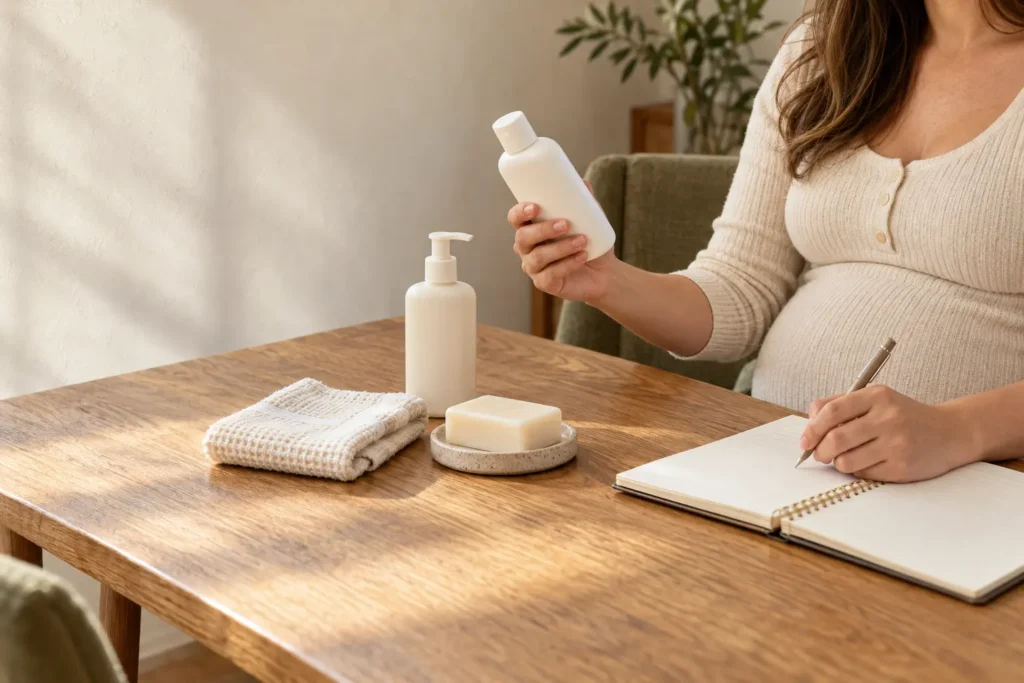
List lotion, body wash, shampoo, hair products, deodorant, perfume, laundry additives and room-fragrance products. Record how each item is used, not just whether it exists in a cabinet. A bottle used every morning and an unopened gift need different decisions. Keep the original package and directions available.
Separate a preference from a medical instruction. You may prefer fewer scented products, while a prescribed topical treatment has a specific clinical purpose. A household inventory can flag a question for your prenatal clinician or pharmacist; it should not become a reason to stop a needed medicine, sunscreen or other protective care without an appropriate alternative.
Use the current label, then ask about the gaps
Check the exact fragrance-free variety and its current information. Some labels describe a fragrance mixture without identifying every component; the FDA fragrance page explains that limitation. If you need an answer about a particular substance, ask the manufacturer using the complete product name. A missing detail is an unresolved question, not proof that a named chemical is present.
Use our label comparison guide for the fragrance-free versus unscented distinction. A retailer filter, clean-beauty category or beige package is not a substitute for matching the actual formula to your goal.
What phthalate and pregnancy research actually asks
Researchers have studied associations between prenatal phthalate biomarkers and pregnancy outcomes. A 2022 pooled study of 16 US cohorts examined urinary exposure markers and preterm birth. This is a reason to take environmental-exposure research seriously. It does not show that a particular household lotion caused a particular pregnancy outcome.
Exposure markers can reflect several sources, and observational studies have limits when identifying causes. A product review cannot measure a person’s total exposure, calculate an individual baby’s risk or promise that changing a detergent prevents preterm birth. Bring questions about your pregnancy to the prenatal team. Keep household actions specific and proportionate to the information available.
Trying to conceive is a conversation for both partners
Environmental questions should not be assigned only to the woman. The NICHD account of the LIFE study describes associations between certain male urinary phthalate markers and a longer time to pregnancy. It did not establish a product-specific cause or show that a fragrance-free shopping list treats infertility.
Both partners can help organize purchases and reduce optional scent products if that is the household preference. If there is difficulty conceiving, do not postpone a suitable fertility evaluation while waiting for a product reset to work. A consultant can help with shopping and information management; assessing reproductive health requires the appropriate clinician.
Build a simple personal-care shortlist
For each essential job, choose a realistic candidate: cleansing, moisturizing or another defined need. Compare the current ingredients, directions, texture, cost and ability to obtain the same product again. Avoid adding several new products merely because they are sold as a pregnancy bundle. A longer routine is not automatically a more thoughtful one.
Preserve useful products that meet the agreed goal and suit the person using them. Fragrance-free does not mean every other ingredient is suitable for every pregnancy or individual. Check concerns about active ingredients, prescribed products or a history of reactions with the relevant professional. Save their advice with the exact item so it can guide the next purchase.
Simplify the room instead of adding a replacement scent
If the goal is fewer added fragrances, leaving out optional plug-ins, sprays and scented candles is a direct change. Replacing them with a diffuser or essential-oil blend introduces another scented product. You do not have to perfume a room for it to feel cared for.
If a room smells damp, smoky or otherwise persistently unpleasant, investigate the actual source. A household inventory can identify what needs attention, but a leak, ventilation fault or smoke problem may require another qualified provider.
In a humid New Orleans home, closing a window to run a stronger scent product is not a plan for the underlying maintenance question.
Write a laundry and visitor note before the baby arrives
Agree on the detergent variety, optional additives you want left out and any relevant textile-care instructions. Use the laundry routine guide to review the entire process. A family member doing a helpful load should not have to guess which almost-identical bottle you meant.
For visitors, make the request simple and courteous: please skip perfume or body spray for this visit and do not add scented products to the baby supplies. This communicates a household preference without diagnosing visitors or claiming their ordinary products will inevitably harm the baby.
Ask the care team about individual infant needs rather than treating a general checklist as neonatal advice.
Plan the budget around repeat purchases
Make a keep list, a replace-next list and a question list. Record the exact item and an acceptable backup so a sold-out product does not send you back to hours of searching. Compare the actual cost per use and the stores you already visit.
A lower-fragrance routine can be simple; it does not require a premium-priced product in every category.
Do not buy a large quantity before you know the product fits the household. Keep returns and substitutions practical. If someone is helping with shopping, give them a photo and the decision rule rather than a vague request for something natural. That is particularly useful when several relatives are buying supplies at the same time.
Bring useful questions to the right person
For the manufacturer: what is in this exact formulation and what does the fragrance-free claim cover? For the prenatal clinician or pharmacist: is there a specific ingredient or treatment concern relevant to me? For Chemical Wellness: can you organize the products, compare practical options and coordinate a shopping plan? Giving each question an owner reduces confusion.
Chemical Wellness offers household education and implementation support in Harvey and Greater New Orleans. Text PREGNANCY with your city and the household task you want help with. You do not need to send medical records to ask about a review. Whole-home packages can combine toiletries, laundry, food and other priorities within an agreed scope.
Related guides and practical household help
- Fragrance, ingredients and hormone-exposure hub
- Fragrance-Free vs. Unscented: How to Read the Label
- Fragrance-Free Laundry: Detergent, Bedding & Residual Scent
- Musk Ambrette & Early Puberty: What the Study Shows
- Pregnancy household preparation
Questions about this guide
Do I need a completely fragrance-free house immediately?
Start with manageable priorities and individual clinical advice. A practical review does not require a panic purge, and nobody can honestly promise a zero-exposure household.
Can changing toiletries prevent a pregnancy complication?
A product change cannot guarantee a pregnancy outcome. Exposure studies examine population-level questions; they do not establish a preventive treatment for an individual pregnancy.
Does fragrance on a label prove phthalates are present?
No. It identifies a fragrance claim or mixture, not every component. Ask the manufacturer about the exact formulation instead of assigning an undisclosed ingredient by assumption.
Are all phthalates the same?
No. They are a group of substances with different uses and evidence. Avoid transferring a finding about one compound or exposure setting to every personal-care product.
Is an essential-oil product automatically the better replacement?
It is another scented formulation. Check the intended use, ingredients and individual suitability rather than treating a plant-based scent as a complete answer.
Should my partner participate in the review?
Yes, shared purchasing and household routines are practical matters for both partners. Fertility concerns also deserve an appropriate assessment rather than placing responsibility on one person’s toiletries.
Should I stop a prescribed skin product?
Do not change a prescribed treatment on the basis of a household checklist. Ask the prescriber or pharmacist about the actual product and a suitable alternative if needed.
Do fragrance-free products guarantee no skin reaction?
No. Other ingredients may still matter to an individual. Keep the label available and seek appropriate advice if a reaction occurs rather than repeatedly trying the product.
What should I ask visitors?
Make a specific, courteous request about optional perfume, body sprays and products brought into the home. Present it as the household routine rather than a claim about a visitor’s health.
Can a consultant interpret my urine exposure test?
Chemical Wellness does not provide clinical test interpretation or an individual reproductive risk assessment. Bring results to an appropriately qualified clinician familiar with the test’s purpose and limits.
Can we review food and household products together?
Yes, the scope can combine shopping and practical household priorities. A defined package explains the time, deliverables and exclusions before any additional work is agreed.
How do I ask about pregnancy household help?
Text PREGNANCY to 504.296.9696 with your city and your main practical priority. A short question is enough to discuss the next step; medical records are not required.
Sources and further reading
Make the next household decision easier.
Tell us your city and the product or routine you want help organizing. We can discuss a defined review before you book.