Fragrance-Free vs. Unscented: How to Read the Label
Less guessing at the shelf. A clearer way to compare the products you bring home.
Updated October 27, 2026 · Chemical Wellness household education
A bottle can smell like almost nothing and still contain ingredients used to cover another smell. That is why fragrance-free versus unscented is a label question before it is a sniff test. If your goal is to reduce added fragrance, start with the exact product and its current information.
You do not need to replace the whole bathroom tonight. You need a repeatable way to decide what stays, what changes next and what requires a better answer from the manufacturer.
The useful difference in two sentences
EPA describes fragrance-free products as having neither fragrance materials nor masking scents. Unscented products may use ingredients to neutralize or cover other ingredients’ odors. That distinction is a useful starting point; it is not a promise that every cosmetic carrying a front-label claim has passed the same independent review.
See the EPA fragrance-free fact sheet and compare the claim with the actual category and formula.
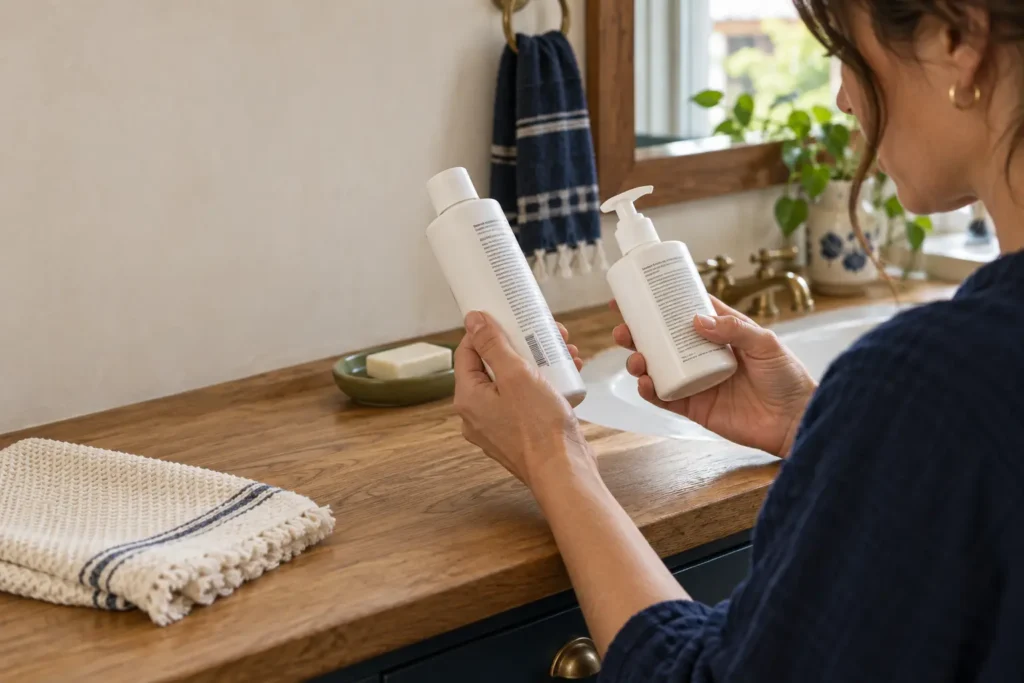
For example, an unscented lotion and a fragrance-free lotion can sit beside each other in nearly identical packaging. Photograph both backs before deciding. The word on the front should lead you to a question you can answer, rather than end the comparison.
Read the product you are actually buying
Record the complete name, size and specific variety. A brand may sell a fragranced formula and a fragrance-free formula under the same product family. A store search result, an old review and the bottle in your cart may describe different versions.
Check that the ingredient information belongs to the same item. If the package and website disagree, save both and ask which formulation is currently supplied.
Keep the original container. Decanting everything into matching decorative bottles makes the room look organized but can separate a product from its directions, warnings and batch details. A useful household system leaves that information available to anyone who needs it.
Look beyond a pleasant front label
On a cosmetic ingredient panel, fragrance may appear as a general mixture rather than a complete list of its components. FDA explains this on its fragrance labeling page. A label therefore has limits: it can identify a declared fragrance mixture without answering every question about that mixture.
Do not replace a missing answer with a guess. Write down what the company discloses, what it does not disclose and whether that matters to your buying rule. If your rule is simply to avoid added scent, a clear fragrance-free option may be easier to maintain than a long debate about an undisclosed blend.
Natural, botanical and essential-oil claims answer a different question
A lavender-scented product is still a scented product when the scent comes from a plant. An earthy label or a leaf graphic does not establish that no fragrance materials were added. Decide whether you are avoiding a particular ingredient, avoiding added fragrance generally or following a clinician’s advice about a specific reaction. Those are different tasks.
For a simple shopping rule, separate the desired job from the desired scent: this product needs to wash hands, moisturize skin or clean a washable surface. It does not need to perfume the room to do that job. Check the full directions and intended use instead of treating the aroma as evidence of cleaning performance.
Use a small comparison worksheet
Compare two realistic options, not twenty open browser tabs. For each one, record the exact item, its intended job, declared fragrance status, ingredient-information source, price per usable amount and where you can obtain it again. Add a final column for unresolved questions. A blank answer is more useful than a confident assumption.
- Product identity: exact name, variety and package photo.
- Formula evidence: current ingredient panel and manufacturer reply, if needed.
- Practical fit: intended surface or body use, directions and storage needs.
- Repeat purchase: size, unit cost and a realistic backup option.
This also helps another family member make the same purchase without accidentally bringing home the scented version.
Understand what a certification does and does not cover
For eligible household products, EPA’s additional Fragrance-Free Safer Choice designation involves a review against its fragrance-free criteria. The ordinary Safer Choice mark alone should not be read as that extra designation. Check the actual product listing, including the variant, instead of relying on a retailer’s badge.
A product certification is evidence about the criteria reviewed. It is not a personal allergy test, a fertility assessment or a guarantee that a product is right for every person and every use. Keep your household decision tied to the specific question the listing answers.
Do not confuse fragrance-free with reaction-proof
A product can omit fragrance and still contain something that does not suit an individual. FDA cautions that cosmetic terms such as hypoallergenic and for sensitive skin do not provide a universal guarantee; see its allergen information.
If a product causes a reaction, stop using it and obtain appropriate advice rather than repeatedly trying it to prove a point.
Keep the package, when it was used and a simple account of what happened for the clinician. A household consultant can organize product information, but identifying a personal allergy belongs with an appropriately qualified professional.
Make the first replacement easy to keep
Start with one frequently used product whose role is clear. Buy a sensible amount, use it only as directed and keep the rest of the routine understandable. If it works for your household, add the exact item to the shopping list.
If it does not, record the practical problem: availability, texture, packaging, cleaning performance or an individual concern. That gives the next comparison a useful starting point.
Changing five products at once makes the results harder to interpret and can waste money. You are building a reliable routine, not collecting a shelf of products with impressive slogans. Existing supplies can be dealt with according to their labels, local disposal guidance and any individual medical advice.
Get help with the actual bottles in your home
Chemical Wellness Solutions can help households in Harvey and Greater New Orleans photograph labels, organize questions and create a replacement list that fits the stores they use. A consultation can combine toiletries with laundry, cleaning supplies and other household priorities. The written scope should identify what will be reviewed and which questions need a manufacturer or licensed professional.
Start by texting LABELS with your city and the two or three products you want help comparing. You do not need to send medical records or private family details. Review the package options before agreeing to a larger whole-home project.
Related guides and practical household help
- Fragrance, ingredients and hormone-exposure hub
- Fragrance-Free Laundry: Detergent, Bedding & Residual Scent
- Fragrance-Free Routines During Pregnancy
- Musk Ambrette & Early Puberty: What the Study Shows
- Ingredient and product education
Questions about this guide
Does unscented mean no fragrance was added?
Not necessarily. Masking ingredients may be used to reduce a formula’s noticeable smell. Check the actual ingredient information and ask the manufacturer when the claim is unclear.
Can a fragrance-free product have an odor?
Yes. The base ingredients may have their own smell. A detectable odor alone does not tell you whether fragrance materials were added; the formulation information matters.
Is natural fragrance the same as fragrance-free?
No. A product scented with botanical materials still has an added scent. Decide whether your goal concerns all added fragrance or one specific ingredient.
Does a plain white bottle prove anything?
No. Packaging is a design choice. Read the exact item’s information rather than assigning meaning to a minimalist bottle, green label or expensive price.
Can I use an old online ingredient list?
Use it only as a lead. Confirm that it describes the current product and variety you are buying, particularly when packaging or product names have changed.
Does the standard Safer Choice logo mean fragrance-free?
Look for the additional fragrance-free designation and the corresponding exact product listing. The ordinary program logo and the fragrance-free designation do not answer the same question.
Is hypoallergenic a guarantee against a reaction?
No. It should not replace attention to an individual’s history, the current ingredient panel and advice from the relevant clinician when symptoms occur.
Should I throw away every scented product?
A label review does not require an instant house-wide purge. Set priorities, consider individual concerns and agree on a replacement and disposal plan that is practical.
Are cleaning-product and cosmetic labels identical?
No. They are different product categories. Use the appropriate disclosure, instructions and certification information for the specific product rather than assuming one labeling rule covers everything.
What should I ask a manufacturer?
Give the exact product name and ask whether the current formula includes fragrance materials or masking scents. Keep the reply with the package information and note its date.
Can this comparison diagnose a fragrance allergy?
No. It organizes product facts. A clinician can assess symptoms and decide whether specific allergy testing or another evaluation is appropriate.
How do I arrange help with labels?
Text LABELS to 504.296.9696 with your city and the product categories you want reviewed. Chemical Wellness can discuss scope and package options before booking.
Sources and further reading
Make the next household decision easier.
Tell us your city and the product or routine you want help organizing. We can discuss a defined review before you book.